
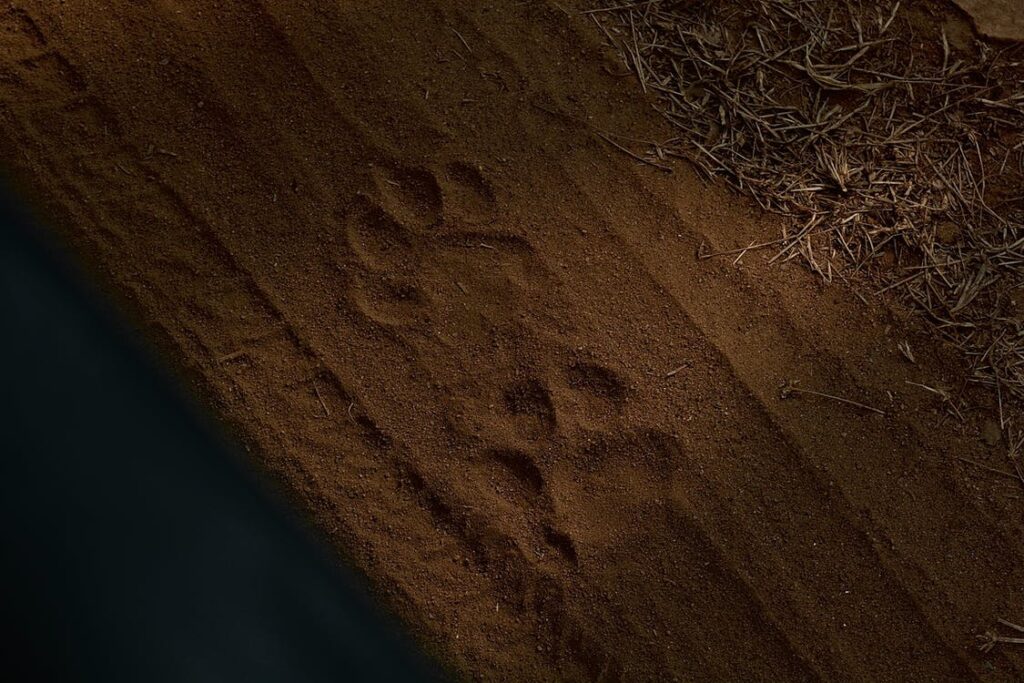
The art and science of tracking demand rigorous attention to detail. Through means of this ancient language, trackers are able to read and understand the natural world.
SANParks’ master tracker James (JJ) Minye recently helped pave the way for a group of students to explore the world around them in a new way. In May, Minye introduced this year’s cohort of students at the Academy for Environmental Leadership SA (AEL) to this age-old practice.
Minye is rated a ‘master tracker’ by CyberTracker, a professional-level wildlife tracking and ecology certification system. There are currently only 19 such trackers in the world.
Under his guidance, 45 AEL students completed a one-week introductory course in tracking near Upington. They were taught the basic principles of systemic tracking (the practice of following a spoor) before heading out into the Kalahari duineveld for four days to put theory into practice.
The course forms part of the extra-curricular activities included in the AEL’s year-long course in conservation ecology. The latter is structured as a transformative academic year spent in nature and earns students a national higher certificate (NQF level 5).
In the tracking shortcourse, students learned to identify the spoor and other signs indicative of 35 different species, including insects, reptiles, birds and mammals. Scat, hair and burrows were just some of the indicators covered.
Together, the students investigated the tracks of antelopes (steenbok, duiker, springbok and gemsbok) and carnivores (yellow mongoose, jackal, aardwolf, African wild cat and caracal), as well as toktokkies, scorpions, ant-lions, earthworms and lizards.
Reading the signs, in the veld and in life
Tracking skills are valuable for all students interested in nature and conservation, says Dr Matthys Strydom, head of the AEL’s academic programme. “By learning to track, students improve their observational skills and foster a general love of nature.”
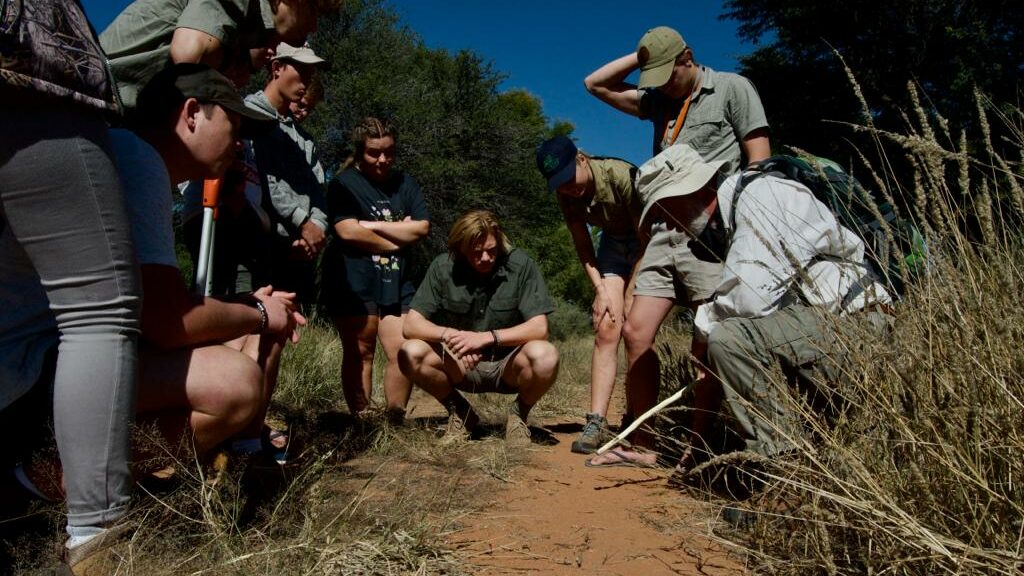
An expert tracker must be able to read between the lines, Minye says. “Besides the more formal uses of the skills developed by tracking, they also have a wide application in our everyday lives. They generally make us more aware of our surroundings.
“Tracking can be applied as a survival skill that allows the user to locate critical resources within his or her environment,” adds Minye.
In order to identify tracks, you must first study the appearance and general biology of the species under investigation. Following and interpreting tracks also require an understanding and appreciation of the species’ behaviour.
A spoor that leads to conservation
Tracking is also a valuable tool in conservation, assisting researchers who study animal behaviour. It can, for instance, indicate the presence or absence of certain species within a given area, signal the arrival of new species, and indicate how suitable the habitat is for different species.
In addition, it has a special role to play in education because it builds observational skills and deductive reasoning. “It awakens critical thinking and leads you to understanding things differently,” Minye adds.
Prof Paul van Helden, a world-renowned expert in animal tuberculosis affecting livestock and wildlife, agrees:
“Everybody sees, but few observe. Tracking enhances the power of observation and develops focusing and interpretation skills.”
Van Helden assisted Minye in teaching the tracking course. Apart from being an emeritus professor in Stellenbosch University’s Division of Molecular Biology and Human Genetics, Van Helden is also one of SANParks’ honorary rangers and a keen tracker himself.
AEL student Daniel Geldenhuys (18) from Stellenbosch says he felt “very privileged” to learn from master tracker Minye. “I was really surprised at the number of tracks I could see and identify on my own on the third day of the course.”